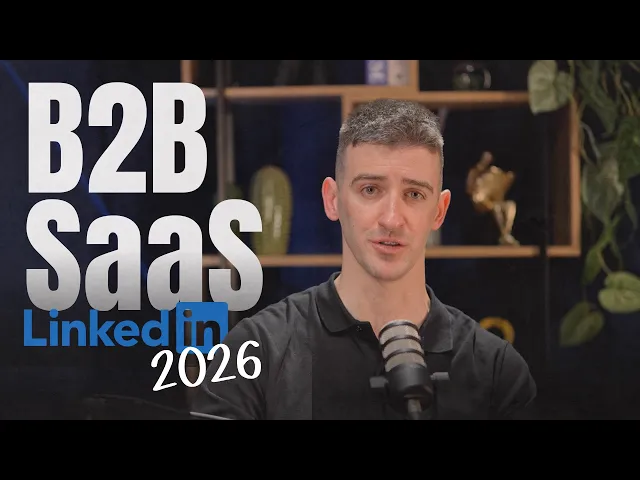
LinkedIn Ads for B2B SaaS in 2026: The Full Playbook
Our 8-year LinkedIn Ads playbook for B2B SaaS: campaign types, audience targeting, ad themes that convert, and measuring pipeline impact.

How to Run LinkedIn Ads for B2B SaaS Companies in 2026 (Full Playbook)
For B2B SaaS, LinkedIn Ads work best when you run Website Traffic campaigns (not Conversion), build audiences around a tightly-held ICP instead of LinkedIn's auto-expansion tools, split targeting into demand creation and demand capture, and measure impact with impression-based attribution instead of last-click. Get those four things right and LinkedIn becomes a reliable pipeline channel rather than a budget sink.

Here's what we actually did
We've seen a significant increase in qualified leads," says David Mcgeough, VP of Marketing at Scorebuddy. In the first 60 days of managing their Google Ads account, we generated 25 sales-accepted leads and eliminated €15,000 in wasted Performance Max spend. Watch the full Scorebuddy case study →
Run traffic campaigns, not conversion campaigns
Website Traffic campaigns should be your default LinkedIn campaign type for B2B SaaS. Not Conversion campaigns.
The reason is data volume. LinkedIn's Conversion campaigns need enough conversion events to optimize properly, and most B2B SaaS accounts simply don't generate enough of them fast enough. Without that data, the algorithm optimizes blind — and you end up overpaying for both impressions and clicks. Traffic campaigns don't have that dependency, so they consistently deliver a cheaper cost per click, which means more impressions and clicks for the same budget.
The other lever most accounts get wrong is bid strategy. LinkedIn's automated bidding (Maximum Delivery) will spend your budget faster and drive your CPC up sharply — in accounts we've audited, we've seen automated bidding push CPC from around $10 to $30 over four weeks, while manual bidding on the same audience held closer to $10–16 over the same period. Use manual bidding and raise it incrementally. Automated bidding trades your budget for LinkedIn's convenience, not your results.
Build audiences around penetration, not expansion
The instinct when a campaign underperforms is to widen the audience for more reach. For B2B SaaS, that's usually the wrong move.
A high frequency against the right ICP outperforms a low frequency against a broad audience that was never going to convert. Every person you add outside your ICP is wasted impression budget — it doesn't buy you upside, it just dilutes spend against people who can't buy.
In practice, this means two things to avoid and one thing to do:
Turn off Audience Expansion. LinkedIn will offer to "reach people similar to your target audience" — don't take it.
Dismiss Auto-Targeting suggestions. The AI-powered targeting based on your product listing sounds efficient, but it optimizes for reach, not fit.
Build your audience manually around job title, seniority level, company size, and industry — and hold that definition tightly rather than loosening it to hit a reach number.
Split your targeting: demand creation vs. demand capture
Don't run one audience pool into one campaign. Segment targeting into two groups, and keep them in separate campaigns so you control bid, budget, and messaging independently for each:
Demand creation — cold audiences who match your ICP on job title, company size, or industry, but haven't engaged with you yet. This is where you introduce the problem you solve.
Demand capture — warmer audiences who've already shown intent. This includes people who've visited your website in the last 30 or 90 days, watched over 50% of one of your videos (organic or paid), or engaged with your LinkedIn company page recently. This is where more direct messaging — case studies, demos — earns its keep.
Blending these into one campaign means you can't tell which spend is building awareness and which is converting intent that already exists, and you can't tune bid or creative for either group separately.
Ad themes that actually convert for B2B SaaS
Six ad content themes consistently perform across the B2B SaaS accounts we manage:
Pain point pressure
Capability first
Reports and playbooks
Book-a-demo messaging
Case studies with established brands
Thought leadership
Thought leadership ads deserve a specific callout. They're producing cheaper CPMs and higher click-through rates than the other five, most likely because they read as authentic rather than salesy in a feed full of obvious ads. If you're not running any thought leadership creative yet, it's the highest-priority gap to close — and organic posts are a low-cost way to test which angles resonate before you put budget behind them.
Measure impact beyond the click
B2B SaaS sales journeys aren't straight lines, and most people who see your ad will never click it. If you're only crediting clicks, you're blind to most of what your ad spend is actually doing.
Impression-based attribution tracks which ads influenced a deal even when the prospect never clicked — which matters more the longer your sales cycle runs. We use and recommend Fibbler for this. Without it, you're making budget decisions on the click-based fraction of your pipeline impact, not the whole picture.
Key takeaways
Run Website Traffic campaigns, not Conversion campaigns — cheaper CPC and more control via manual bidding.
Prioritize audience penetration of your ICP over audience expansion; turn off Audience Expansion and dismiss Auto-Targeting.
Build audiences manually around job title, seniority level, company size, and industry.
Split campaigns into demand creation (cold ICP) and demand capture (warm, intent-shown audiences).
Rotate ad themes — pain point, capability, reports/playbooks, demo asks, case studies, thought leadership — and let organic posts test what resonates first.
Thought leadership ads currently outperform on CPM and CTR for B2B SaaS.
Measure with impression-based attribution, not last-click, especially for longer sales cycles.
How to Run LinkedIn Ads for B2B SaaS Companies in 2026 (Full Playbook)
For B2B SaaS, LinkedIn Ads work best when you run Website Traffic campaigns (not Conversion), build audiences around a tightly-held ICP instead of LinkedIn's auto-expansion tools, split targeting into demand creation and demand capture, and measure impact with impression-based attribution instead of last-click. Get those four things right and LinkedIn becomes a reliable pipeline channel rather than a budget sink.

Here's what we actually did
We've seen a significant increase in qualified leads," says David Mcgeough, VP of Marketing at Scorebuddy. In the first 60 days of managing their Google Ads account, we generated 25 sales-accepted leads and eliminated €15,000 in wasted Performance Max spend. Watch the full Scorebuddy case study →
Run traffic campaigns, not conversion campaigns
Website Traffic campaigns should be your default LinkedIn campaign type for B2B SaaS. Not Conversion campaigns.
The reason is data volume. LinkedIn's Conversion campaigns need enough conversion events to optimize properly, and most B2B SaaS accounts simply don't generate enough of them fast enough. Without that data, the algorithm optimizes blind — and you end up overpaying for both impressions and clicks. Traffic campaigns don't have that dependency, so they consistently deliver a cheaper cost per click, which means more impressions and clicks for the same budget.
The other lever most accounts get wrong is bid strategy. LinkedIn's automated bidding (Maximum Delivery) will spend your budget faster and drive your CPC up sharply — in accounts we've audited, we've seen automated bidding push CPC from around $10 to $30 over four weeks, while manual bidding on the same audience held closer to $10–16 over the same period. Use manual bidding and raise it incrementally. Automated bidding trades your budget for LinkedIn's convenience, not your results.
Build audiences around penetration, not expansion
The instinct when a campaign underperforms is to widen the audience for more reach. For B2B SaaS, that's usually the wrong move.
A high frequency against the right ICP outperforms a low frequency against a broad audience that was never going to convert. Every person you add outside your ICP is wasted impression budget — it doesn't buy you upside, it just dilutes spend against people who can't buy.
In practice, this means two things to avoid and one thing to do:
Turn off Audience Expansion. LinkedIn will offer to "reach people similar to your target audience" — don't take it.
Dismiss Auto-Targeting suggestions. The AI-powered targeting based on your product listing sounds efficient, but it optimizes for reach, not fit.
Build your audience manually around job title, seniority level, company size, and industry — and hold that definition tightly rather than loosening it to hit a reach number.
Split your targeting: demand creation vs. demand capture
Don't run one audience pool into one campaign. Segment targeting into two groups, and keep them in separate campaigns so you control bid, budget, and messaging independently for each:
Demand creation — cold audiences who match your ICP on job title, company size, or industry, but haven't engaged with you yet. This is where you introduce the problem you solve.
Demand capture — warmer audiences who've already shown intent. This includes people who've visited your website in the last 30 or 90 days, watched over 50% of one of your videos (organic or paid), or engaged with your LinkedIn company page recently. This is where more direct messaging — case studies, demos — earns its keep.
Blending these into one campaign means you can't tell which spend is building awareness and which is converting intent that already exists, and you can't tune bid or creative for either group separately.
Ad themes that actually convert for B2B SaaS
Six ad content themes consistently perform across the B2B SaaS accounts we manage:
Pain point pressure
Capability first
Reports and playbooks
Book-a-demo messaging
Case studies with established brands
Thought leadership
Thought leadership ads deserve a specific callout. They're producing cheaper CPMs and higher click-through rates than the other five, most likely because they read as authentic rather than salesy in a feed full of obvious ads. If you're not running any thought leadership creative yet, it's the highest-priority gap to close — and organic posts are a low-cost way to test which angles resonate before you put budget behind them.
Measure impact beyond the click
B2B SaaS sales journeys aren't straight lines, and most people who see your ad will never click it. If you're only crediting clicks, you're blind to most of what your ad spend is actually doing.
Impression-based attribution tracks which ads influenced a deal even when the prospect never clicked — which matters more the longer your sales cycle runs. We use and recommend Fibbler for this. Without it, you're making budget decisions on the click-based fraction of your pipeline impact, not the whole picture.
Key takeaways
Run Website Traffic campaigns, not Conversion campaigns — cheaper CPC and more control via manual bidding.
Prioritize audience penetration of your ICP over audience expansion; turn off Audience Expansion and dismiss Auto-Targeting.
Build audiences manually around job title, seniority level, company size, and industry.
Split campaigns into demand creation (cold ICP) and demand capture (warm, intent-shown audiences).
Rotate ad themes — pain point, capability, reports/playbooks, demo asks, case studies, thought leadership — and let organic posts test what resonates first.
Thought leadership ads currently outperform on CPM and CTR for B2B SaaS.
Measure with impression-based attribution, not last-click, especially for longer sales cycles.

Let's Talk Growth
If you want to achieve ground-breaking growth with increased sales and profitability with paid ads, then you're in the right place.
Let's Talk Growth
If you want to achieve ground-breaking growth with increased sales and profitability with paid ads, then you're in the right place.
Let's Talk Growth
If you want to achieve ground-breaking growth with increased sales and profitability with paid ads, then you're in the right place.